


Every technology leader wants outcomes: better customer experiences, faster delivery, lower operating costs, AI initiatives that succeed. Yet most organizations aren’t structured to buy outcomes. Instead, many procurement processes are designed to buy headcount, not outcomes.
Before comparing firms, rates, or proposals, there’s a more important question to answer:
What do we need this consulting partner to own?
The answer shapes everything that follows. It determines how the engagement is structured, how success is measured, how accountability is shared, and whether the client and consulting partner are working toward the same objective.
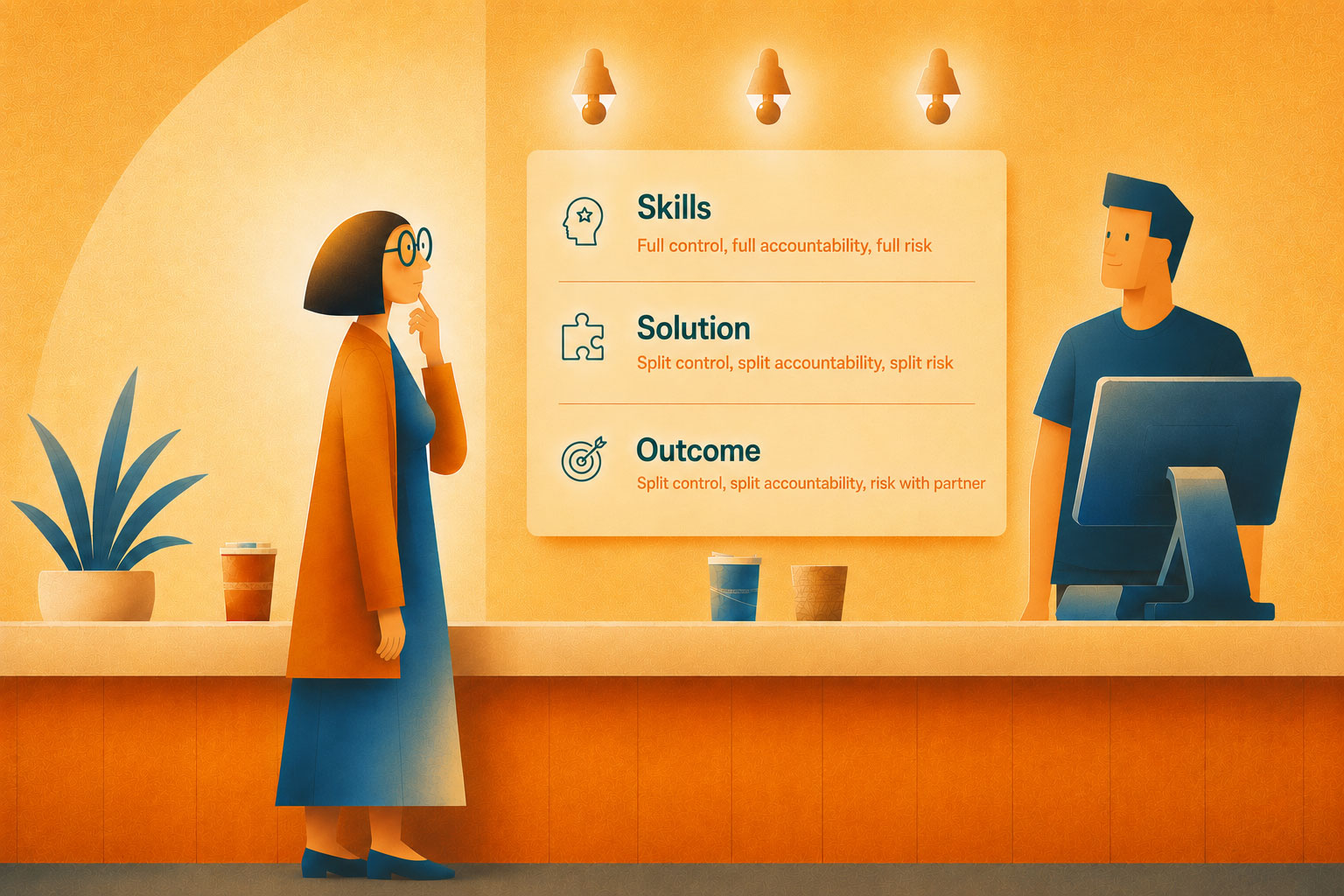
There are three fundamentally different ways to engage a consulting partner. You’re buying skills, a solution, or an outcome. Each model transfers control, accountability, and risk differently between the client and the consulting partner.
None of these models is inherently better than the others. Each is appropriate in the right situation. Problems arise when organizations buy one model while expecting another.
The most common engagement is buying skills. A client needs experienced engineers, architects, designers, project managers, or AI specialists to strengthen an internal team. The contractor provides expertise, while the client continues to set priorities, make key decisions, and own the overall result. This model gives the client the greatest control, but it also leaves the client with the greatest responsibility for the outcome. In many situations, that’s exactly the right choice.
Buying a solution is different. Here, the need isn’t additional capacity but delivery. Whether it’s migrating a platform, building a new application, replacing a legacy system, or implementing an AI capability, the consulting partner is responsible for delivering a solution that the client has defined. The client continues to own business priorities, organizational change, executive decisions, and adoption. Success depends on both sides fulfilling their responsibilities.
Buying an outcome is the model every executive wants. The objective is no longer to deliver a defined solution, but to achieve a measurable business result: improve customer satisfaction, reduce operating costs, increase revenue, or make an AI initiative successful.
This is also the model that’s easiest to misunderstand.
Business outcomes rarely depend on technology alone. They depend on leadership decisions, funding, organizational priorities, user adoption, business processes, and change management. A consulting partner can influence many of those factors, but cannot control them without support from executive clients. That’s why outcome-based engagements only work under specific conditions. They require the consulting partner to have meaningful influence over the decisions that determine success. Without that, the engagement isn’t truly outcome-based, regardless of how it’s sold.
Organizations rarely choose the wrong engagement model on purpose. Different parts of the organization are solving different problems.
A manager trying to close a staffing gap naturally thinks about skills. A program leader responsible for delivering a project thinks about solutions. An executive accountable for business performance thinks about outcomes.
None of those perspectives is wrong. But by the time procurement issues the RFP, the real need may have been converted into a headcount when really an outcome or solution is what was needed. The contract describes one engagement model while leadership expects another.
The pattern is familiar. A team is staffed to strengthen engineering capacity, but the steering committee begins tracking the engagement as if someone committed to delivering a business outcome. Eighteen months later, both sides are frustrated and pointing to a contract that was never designed to carry that weight.
Nothing necessarily went wrong during delivery. The engagement was simply designed for one model while the organization expected another.
A true outcome-based engagement requires more than a willing consulting partner. It requires an organization where someone has the authority to align priorities, make decisions, remove obstacles, and own the result. In reality, those responsibilities are usually spread across multiple leaders. One executive owns the budget. Another owns technology. Someone else owns operations. Another team owns adoption.
When accountability is distributed across the organization, it becomes difficult to transfer accountability to a consulting partner. That’s an organizational design problem, not a contracting one.
Procurement processes tend to reinforce that reality because they’re designed to buy headcount. They evaluate hourly rates, resumes, role descriptions, and staffing plans. That’s exactly what you should evaluate when you’re buying skills. It’s less useful when you’re buying a solution, and it’s often the wrong place to start if you’re trying to buy a business outcome.
As a result, organizations often say they want outcomes while structuring the engagement around people and hours. The buying process reflects one model and the expectations another.
Clients aren’t the only ones who need to be honest about accountability.
Consulting partners should be held to the same standard.
If a firm says it will deliver business outcomes, what decisions will it control? What risks is it willing to absorb and what happens if priorities change halfway through the engagement?
These aren’t commercial details to negotiate after the contract is signed. They’re strategic questions that determine whether the engagement model matches the outcome both sides expect to achieve.
The strongest partnerships begin with a shared understanding of where accountability starts and ends, and what each party owns.
Before comparing rates, proposals, or staffing plans, ask a simpler question.
What do we actually need this consulting partner to own?
Do we need additional capability, a delivered solution, or a measurable business outcome?
That single decision shapes everything that follows, from pricing and governance to success measures and partner selection. It’s also the decision that determines whether expectations are aligned before the work begins.
When consulting engagements fail, it’s often because the client and the consulting partner believe they’re solving different problems.
If you’re planning an AI initiative, a modernization effort, an acquisition, or another major technology investment, start by deciding what you need a partner to own.
If you’re working through that decision now, we’d be happy to help. It’s worth having that conversation before the RFP goes out.
