Architecture assessment
One agreed picture of your architecture
Built before your next major decision. Delivered in weeks.
See How It Works


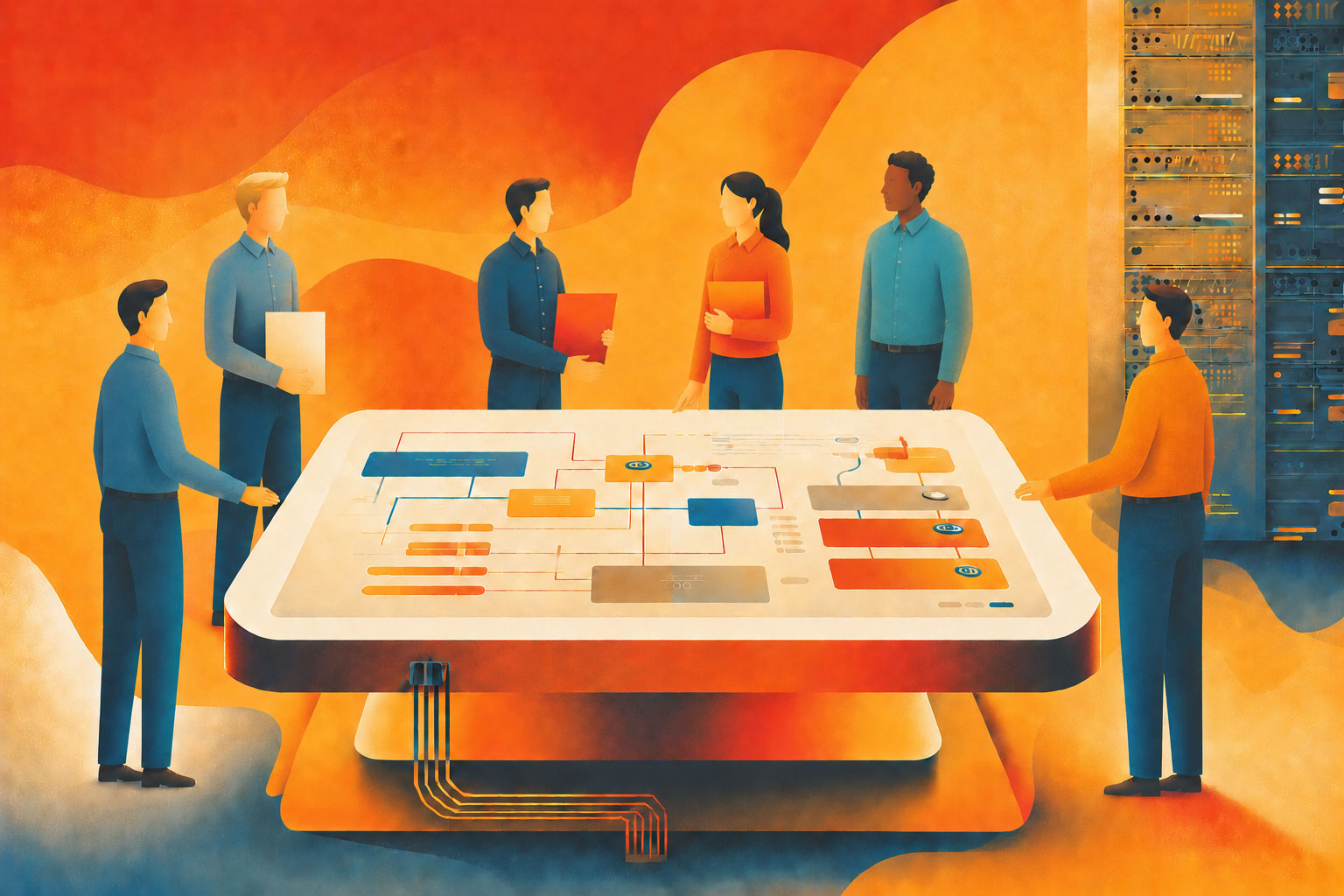
The cost of knowing your own architecture has changed. Engineering leaders have long wanted a current architecture model. The historical cost was high enough that maintaining the architectural artifacts always lost out to delivery priorities, and the artifacts aged into something that looked authoritative but wasn't current. AI has reduced that effort to the point where the discipline is finally justifiable.
Building a thorough current-state model of a mature medium-scale system meant months of senior engineering time on discovery sessions, manual synthesis, and review rounds with subject matter experts. By the time the model was complete, parts of it were already out of date. Keeping it current called for a similar effort quarterly, indefinitely. That effort eventually lost out to delivery priorities.
Automated discovery now runs against the sources that already describe a deployed system: infrastructure-as-code, CI/CD pipelines, API registries, service catalogs, and observability tooling. A candidate inventory of systems, services, and their dependencies can be created before the first expert session. Discovery becomes confirm-and-correct rather than start-from-nothing.
A medium-scale assessment that used to take three months now runs in three weeks, and most of that time is consumed scheduling subject matter experts to confirm the findings. With such shortened timelines, the artifact maintenance discipline that previously lost out can now fit alongside delivery, creating truly living documentation. Architecture as code. Machine-readable system models. The names vary. The shared idea is a structured picture of the system, versioned alongside the code, and current enough to be useful to humans and agents alike. The economics behind that idea have only recently caught up to the ambition.
Cheaper to maintain is one shift. The bigger one is what the model is now used for.
The conversation about AI engineering has shifted. Across the industry, 2026 is being framed as the year of context. Anthropic and Google have published extensively on context engineering as the discipline replacing prompt engineering at scale. The consensus across IT leadership is that prompt work alone is no longer enough to make AI systems reliable in production.
Like people, AI agents working on infrastructure, migrations, or code review are only reliable if they understand the architecture of the system they are working on. A current architecture model is the highest-fidelity context they can have. Without it, AI tools generate output that looks plausible but is often wrong about the specifics of your environment.
Teams trying to scale AI engineering hit this gap. They diagnose it as a model problem, prompt problem, or agent design problem. The real issue is context. Architecture tells AI how the system’s various parts fit together and run. However, while architecture is essential, it is not sufficient. Architecture doesn't explain what the business means, the language it uses to explain itself, for this a domain model is also needed
Paired foundations
Architecture modeling and domain modeling are paired foundations. Domain models capture what the business means: the entities, definitions, and relationships. Architecture models capture how the technology works: what's deployed, what depends on what. Together, they are the foundation of any AI-driven software development organization. Either alone leaves AI tools working with half the picture.
For teams that maintain both, a new initiative starts from a foundation that other organizations spend the first weeks of an engagement assembling. An architectural decision begins with a shared picture rather than a debate over what exists. A new engineering leader inherits a map on day one rather than spending six months reconstructing one.
A domain model, if it exists today, was probably scoped for one project and frozen. The architecture diagrams sit somewhere on Confluence, last touched 18 months ago by an engineer who has since left. The senior people who do know the system carry it in their heads. That knowledge isn't accessible to anyone else.
As paired foundations, the two models close the gap between what the business intends and what the technology does, which is where AI implementation problems tend to start.
A model people and AI agents acting on their behalf across the organization can act on has to be one they can audit.
Review is the discipline that makes AI-assisted work trustworthy. We place expert review and SME validation between automated extraction and the delivered model. Each entry carries provenance and approval metadata, making the work auditable from automated extraction through to the final model.
The same AI techniques that make architecture modeling affordable also produce errors. Automated extraction can misread a dependency. An entity can get duplicated. Two distinct names can be collapsed into one. These errors are real and predictable, and the discipline for handling them is the discipline any reviewable artifact needs. In every model we produce, each entry carries provenance metadata that makes clear what came from a system, what came from a reviewer, and what came from a subject matter expert. Together, the provenance and approval mechanism are the difference between a model that people can act on and one that no one quite trusts.
This is where our approach diverges from both fully manual assessments and pure automation. Neither extreme works. One is too slow, and the other is too error-prone
Three examples, doing different work for the argument.
When a leading US online real estate marketplace set out to modernize the lead tracking and referral platform at the center of their core business, the question wasn't whether to decouple the monolith. It was where to start, in what order, and at what cost. We modeled the current architecture, developed the technical strategy alongside their senior technical leaders, and ran a multi-tracked, multi-phase decoupling alongside their teams. The model anchored each phase as the work continued.
When a major SMB accounting software vendor was evaluating a SaaS payroll acquisition, we ran an independent technical audit of the product, the engineering process, and operability. The review surfaced architectural constraints affecting the target's speed to market. The buyer used the findings to walk away from the deal, with the documented basis to defend the decision. A leadership team that walks into diligence with that kind of picture can make the call from evidence rather than instinct.
For a global music service we worked with, an architecture model SPAN built has stayed in use across hundreds of engineers. The team uses it to onboard new engineers, map dependencies, catalog technical debt, and support design and planning, all from the same shared reference, queried and maintained through a SPAN-built tool. In that story, the model isn't a one-time deliverable. It's institutional infrastructure.
In our engagements, we have found that roughly 30% of deployed mircoservices have no identifiable current owner. The first useful output is often that list, handed to engineering leadership before anything else changes.
What ties these cases together is what we started with.
The barrier that made ongoing architecture modeling impractical has dropped. The same is true of domain modeling. For the first time, both can be maintained as living assets rather than periodic rebuilds that catch the system as it was a year ago.
Teams that build this foundation spend less time reconstructing context when a decision arrives, get more reliable output from the AI tools their engineers are already using, and walk into the major moments (acquisitions, modernizations, leadership transitions) with answers in hand. The next decision starts further forward than the last one.
Before commissioning this work, there's a useful test you can run with your own team this week. Ask two questions. Which services would be affected if you took down your most critical service tomorrow, and how long would it take your team to answer? How many services do you have running with no identified current owner? The answers separate organizations working from a current picture from those reconstructing one each time a decision arrives.
If you're scaling AI in engineering, contemplating an acquisition, embarking on a modernization program, or settling in as a new engineering leader in your first 90 days, and the architectural picture isn't current, let's talk. We can have a useful first read in three weeks.

